All Roads Lead to Rome

Flow-driven Multi-Anchor Exploration
for Open-Environment Active 3D Mapping

Yang Li1 Aming WU2 Zihao Zhang1 Ziju Han1 Sijia Zhang1 Yahong Han1
NeurIPS 2026(Spotlight)
1Tianjin University 2Hefei University of Technology
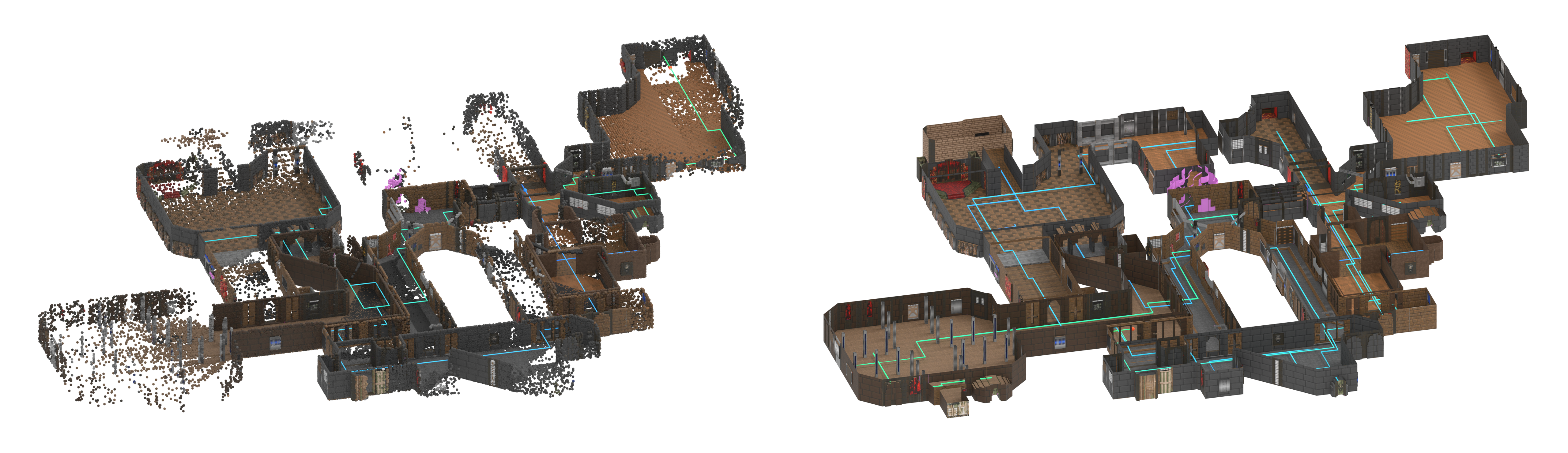
fear_in_the_abyss_10, matching low-angle cameras and roof cutaways. Left: actual Simple-trained NBP reconstruction and recorded trajectory, with 70.04 percent measured coverage. Right: complete Ground Truth scene with recorded and illustrative orthogonal room routes, not an exploration result.

Left: Previous state of the art: NextBestPath.

Right: Our method.

Preserving multiple exploration hypotheses for efficient active 3D mapping in unseen environments.

Overview

  • We study active 3D mapping in open environments, where partial observations and scene shifts make a single long-horizon goal difficult to predict reliably.
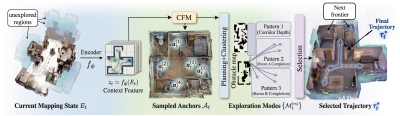
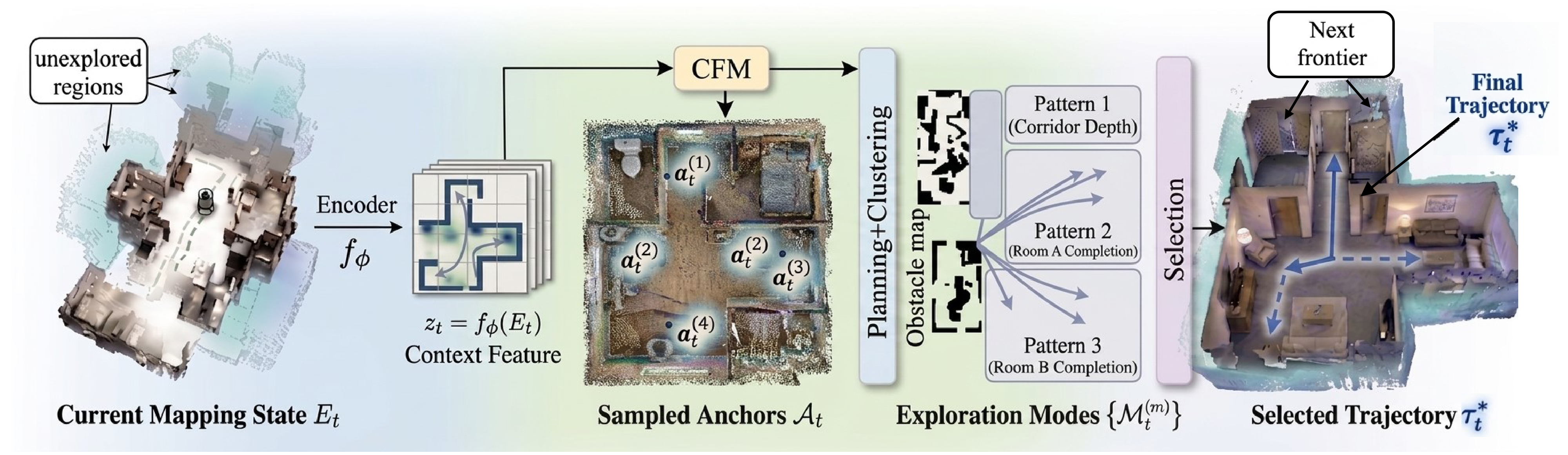
  • We formulate exploration as conditional multimodal anchor generation. Conditional Flow Matching preserves multiple plausible goals, while obstacle-aware planning converts them into executable paths.
  • Exploration-mode clustering reduces redundant candidates. Hierarchical selection chooses an exploration mode and reranks its paths to produce the next trajectory.

Motivation

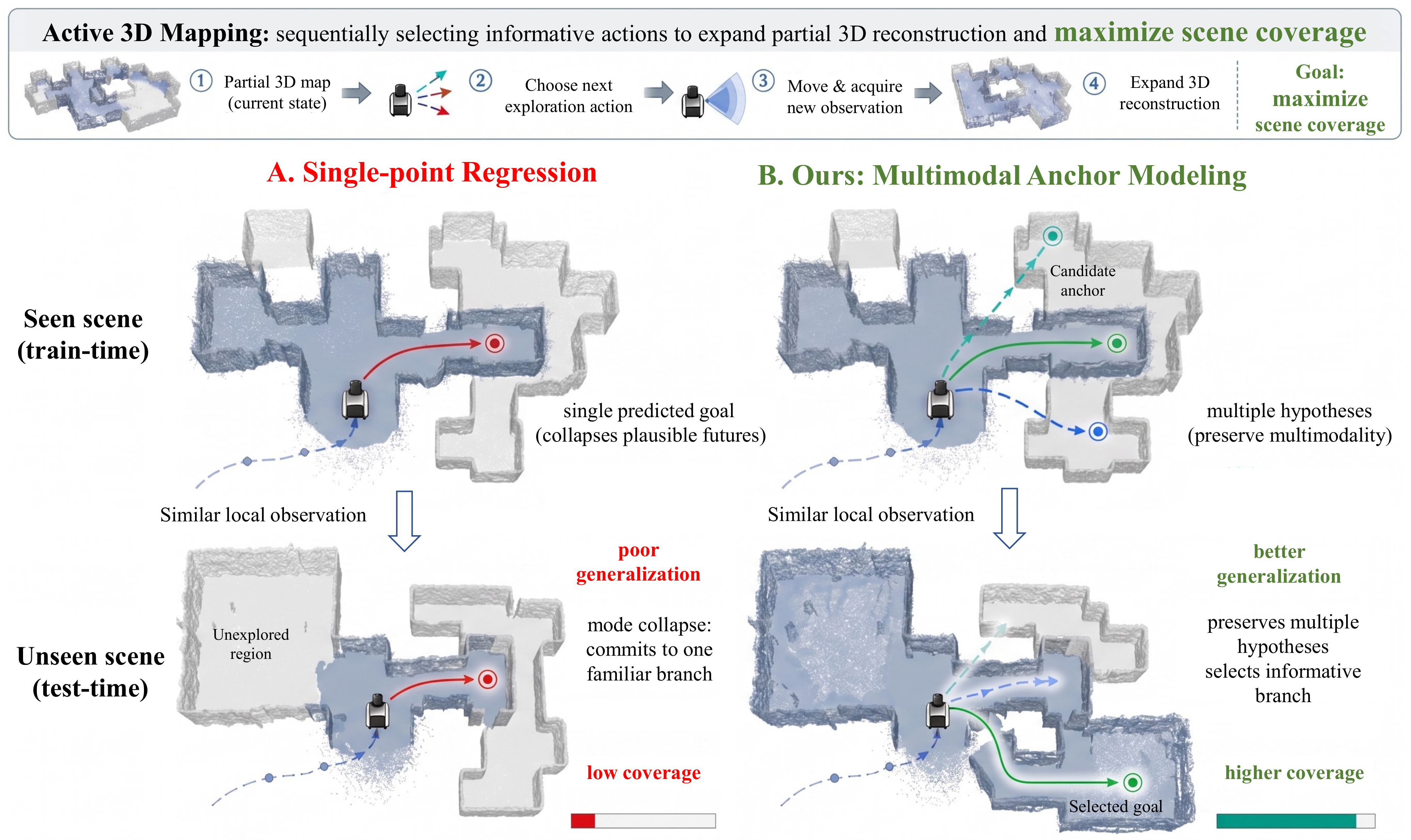
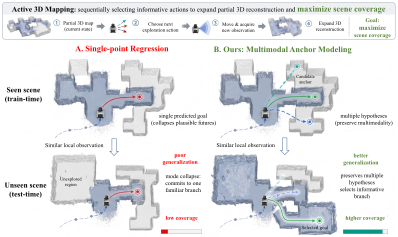
Single-point regression commits to a familiar branch, while multimodal anchor modeling preserves alternative exploration hypotheses under scene shift
Under partial observability, similar local observations can support multiple plausible futures. Multimodal anchor modeling preserves these alternatives before planning, allowing the agent to explore informative branches in unseen scenes.

Architecture

Mapping state encoder, conditional flow matching anchors, obstacle-aware planning and clustering, and hierarchical trajectory selection
A mapping-progress encoder summarizes the current state. Conditional Flow Matching samples long-horizon anchors, which become feasible candidate paths through obstacle-aware planning. Clustering groups similar paths into exploration modes, and hierarchical selection produces the final executable trajectory.

Conditional Flow Matching

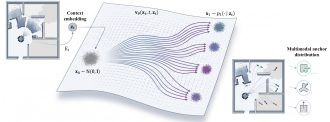
Conditional flow transports Gaussian samples to several plausible long-horizon anchor modes conditioned on the mapping state
Conditioned on the current mapping state, a learned flow transports samples from a Gaussian prior to a multimodal distribution of coarse exploration anchors. Modeling position and orientation in a compact anchor space leaves detailed geometric feasibility to the planner.

Evaluation Results

Our method achieves improved reconstruction coverage and exploration efficiency on the AiMDoom and Matterport3D benchmarks.

Manuscript Tables 1–3: evaluation on AiMDoom, comparison on Matterport3D, and transfer from AiMDoom to Matterport3D.

More Comparisons

Active mapping in two Hard scenes

Previous state of the art

Our method
Previous state of the art

Our method